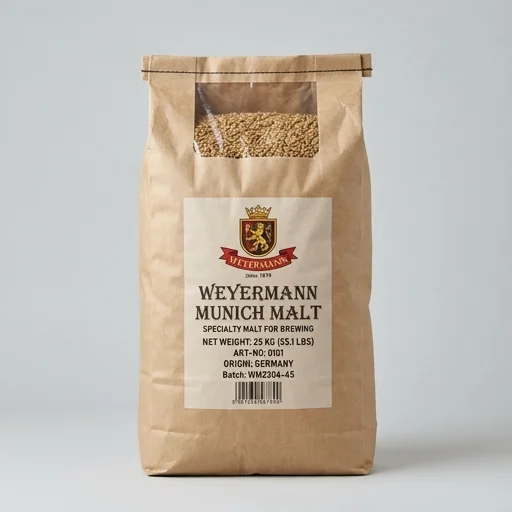
What you get with the Weyermann Munich Malt
Weyermann Munich Malt is a premium German base-adjacent specialty grain prized by homebrewers for its rich malty depth and beautiful color contribution. Produced by the renowned Weyermann malting house in Bamberg, Germany, this malt is kilned at higher temperatures than standard pale malts, developing deep melanoidin compounds that impart a pronounced bready, toasty, almost sweet richness to beer. Available typically in two color ranges, Munich Malt I and Munich Malt II, it allows brewers to dial in anywhere from a warm amber hue to deeper copper and reddish-brown tones depending on the percentage used in the grain bill. Its flavor profile brings notes of toasted bread crust, biscuit, and a subtle honey-like sweetness that rounds out the body of the finished beer.
This malt is a cornerstone ingredient for traditional German styles such as Munich Dunkel, Oktoberfest/Märzen, Bock, and Doppelbock, where its signature malt-forward character defines the beer's identity. Homebrewers also reach for it to add complexity and color to amber ales, brown ales, Scottish ales, and even some robust porters when a malty backbone is desired without excessive roast bitterness. Because Weyermann Munich Malt retains enough diastatic power to self-convert in moderate proportions, it can be used anywhere from a supporting 10-20% addition up to forming the majority of the grain bill in full Munich-style recipes, giving brewers flexibility depending on the intensity of malt character they're chasing. Its consistent quality and well-documented specifications make it a reliable choice for recipe formulation, whether brewing an all-grain batch or supplementing an extract-based recipe with specialty grain steeping.
Sourced from carefully selected European barley, Weyermann's floor-malting heritage and meticulous kilning process ensure that each batch of Munich Malt delivers consistent enzymatic activity, moisture content, and color specification batch after batch. The grain arrives whole, ready for milling at home, and is best stored in a cool, dry environment in an airtight container to preserve freshness prior to brew day. Many homebrewers consider it an essential pantry staple alongside their base malts, reaching for it whenever a recipe calls for added malt complexity, improved mouthfeel, or that unmistakable deep golden-to-amber color synonymous with classic Bavarian brewing tradition. Whether you're crafting an authentic Oktoberfest lager or simply want to deepen the malt character of an ale, this specialty grain delivers dependable, flavorful results.
- German-grown 2-row barley base malt
- Kilned to develop rich malty flavor and deeper color
- Available in Munich I (light) and Munich II (dark) variants
- Enzymatic power sufficient for self-conversion in mashes
- Imparts bready, toasty, slightly sweet malt character
- Suitable for single-malt Oktoberfest and Bock recipes
- Consistent batch-to-batch quality from Weyermann's Bamberg facility
Technical specifications
- Origin
- Germany (Bamberg)
- Color (Munich I)
- 6-8 °Lovibond
- Color (Munich II)
- 8-10 °Lovibond
- Diastatic Power
- 140-170 °WK
- Typical Usage Rate
- 10-100% of grain bill
Pros & cons
+What we like
- Adds deep malty complexity without harsh roast notes
- High diastatic power allows use as majority grain bill
- Produces beautiful amber-to-copper color in finished beer
- Versatile across many German and American beer styles
- Well-documented specs and trusted European sourcing
- Enhances head retention and malt-forward aroma
−Watch out for
- Can overpower delicate or hop-forward recipes if overused
- Slightly pricier than basic domestic base malts
- Darker Munich II variant has reduced enzymatic activity
- Requires proper crush to avoid stuck sparges due to husk density
- Flavor intensity may need recipe adjustment for beginners
Should you buy it?
Weyermann Munich Malt is a premium German base malt prized by homebrewers for its rich, bready malt character and reliable enzymatic strength. Whether used as a backbone for Oktoberfests, Bocks, or as a flavor-enhancing addition to ales, it consistently delivers deep color and robust malt complexity. A worthwhile investment for brewers seeking authentic German lager and amber ale profiles.
Check price on Amazon